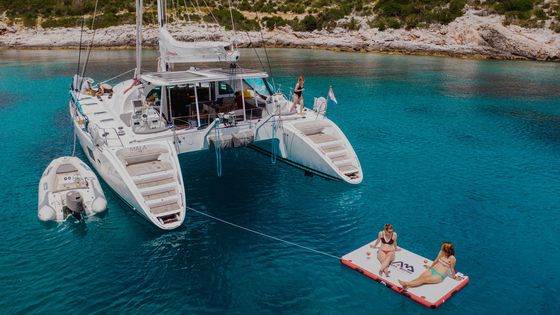
If you've ever scrolled past stunning photos of sun-drenched sailors anchored off crystalline Croatian bays or watched a reel of friends toasting sundowners on a catamaran in the Aegean, chances are you've stumbled across Yacht Week — the legendary sailing festival that's become the hottest item on every adventurous traveler's bucket list.
But here's the thing: Yacht Week has gotten crowded. And expensive. And very, very Instagram-famous.
The good news? The same magic — a private yacht, a week on the water, crystal-clear Mediterranean bays, great company, and total freedom — is available in a handful of stunning alternative destinations that offer the same experience at a fraction of the price and crowds. We're talking destination dupes: places that deliver all the Yacht Week energy with none of the overcrowding.
In this guide, we'll break down everything you need to know about Yacht Week, answer your most-asked questions (yes, including how much it costs), and then introduce you to six incredible alternative destinations to consider for your own sailing week.
What Is Yacht Week?
Yacht Week is an organized international sailing experience that combines yacht charters with a curated itinerary of social events, beach clubs, and island-hopping adventures. It's not just a boat trip — it's a week-long floating festival designed around a community of sailors who move together through some of the world's most beautiful coastlines.
Here's how it works: you book a spot on a yacht (or rent the whole boat for your group), then join a "flotilla" — a convoy of anywhere from 10 to 50+ yachts all following the same weekly route. Each evening, the fleet congregates at a designated anchorage, beach bar, or marina for communal dinners, parties, and general revelry. Days are spent sailing, swimming, snorkeling, and exploring local towns.
There are official Yacht Week organizers (like The Yacht Week, the original brand founded in Croatia in 2006) as well as countless independent groups who chart their own course with private charters. Both options give you the quintessential sailing holiday experience.
Where Is Yacht Week?
Where is Yacht Week held? The original and most famous location is Croatia — specifically the Dalmatian Coast, running between Split and Dubrovnik along a chain of gorgeous limestone islands. But Yacht Week has expanded significantly over the years.
Current destinations include:
- Croatia — Dalmatian Coast (the original and most popular route)
- Greece — the Cyclades (Santorini, Mykonos, Paros, Naxos) and the Ionian Islands
- Montenegro — the Bay of Kotor and the Adriatic coast
- British Virgin Islands (BVI) — Caribbean winter sailing
- Thailand — the Andaman Sea around Phuket and Phang Nga Bay
- Turkey — the Aegean and Turquoise Coast (Bodrum, Göcek)
- Azores, Portugal — Atlantic islands sailing
Each destination has its own character, sailing conditions, and party culture. Croatia remains the crown jewel for summer Mediterranean sailing, while the BVI and Thailand attract winter escapees.
When Is Yacht Week?
When is Yacht Week? The Yacht Week season for Mediterranean destinations (Croatia, Sicily, and Santorini) runs from late May through late September, with peak weeks falling in July and August. Organized flotilla companies like The Yacht Week run departures most weeks throughout this window, with each week assigned a different "theme" or social schedule.
The most popular (and most expensive and most crowded) weeks are mid-July through mid-August. For a better balance of weather, value, and crowd levels, aim for:
- Late May / June — warm, calm seas, fewer tourists, best prices
- Early September — still hot, far fewer crowds, excellent sailing winds
- Late September — shoulder season deals, quieter anchorages, local vibe
If you're chartering independently rather than joining an organized flotilla, you have the flexibility to go any week within the season — which is part of why DIY charters are growing in popularity.
How Much Does Yacht Week Cost?
How much does Yacht Week cost?
This is the question everyone asks, and the answer depends on whether you're joining an organized event or booking independently.
Organized Yacht Week Packages
With operators like The Yacht Week, pricing typically covers:
- A spot on a pre-allocated yacht (shared with other guests)
- Access to the weekly social program, events, and beach clubs
- Some meals or drinks packages (varies by tier)
Expect to pay approximately €800–€2,500+ per person for an organized Yacht Week package, depending on cabin type (shared vs. private), boat quality, destination, and season. This usually excludes flights, food/drink beyond included events, and tips.
Independent Charter (DIY Yacht Week)
Many groups now skip the organized package entirely and charter their own yacht for the week, creating their own itinerary — often at lower overall cost with more privacy and flexibility.
How much to charter a yacht for a week? Typical bareboat charter costs (boat only, you captain it or bring a skipper) range from:
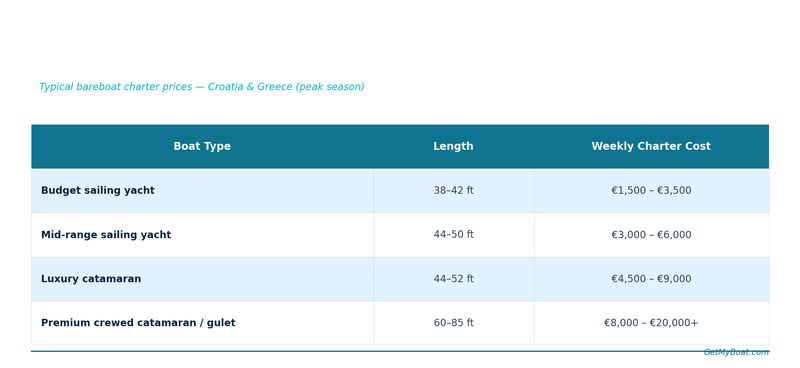
Split among 8–12 people, even a mid-range crewed catamaran can come out to €500–€900 per person for the boat alone — often cheaper than an organized Yacht Week package, and with far more freedom.
How much to charter a yacht in Santorini? Greece's famous volcanic island sits in the Cyclades, one of the most popular — and priciest — sailing grounds in the Med. Expect charter base prices of €4,000–€12,000/week depending on boat type and season, with July–August at peak rates. Adding a skipper and provisioning typically adds €200–€400/day.
Ready to charter your own yacht? Browse thousands of boats in Croatia, Greece, and beyond on Getmyboat — from affordable sailing yachts to luxury catamarans, with or without a captain.
How Many People Can Sleep on a Yacht for Yacht Week?
How many people can sleep on a yacht during Yacht Week? This varies significantly by boat type:
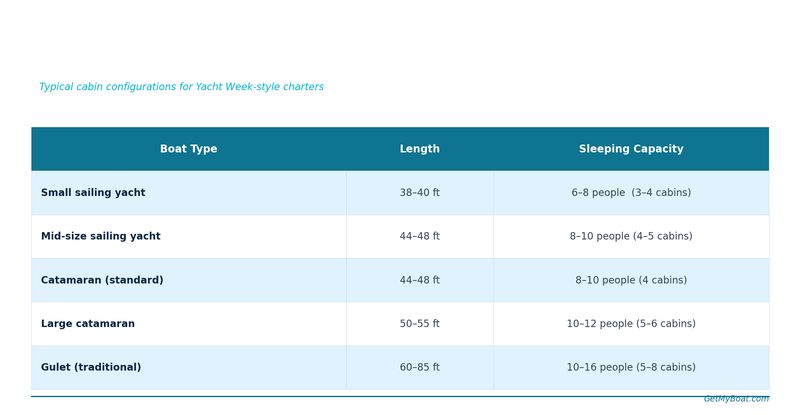
For Yacht Week in the Mediterranean specifically, the most popular configuration is a 44–48 ft sailing yacht or catamaran sleeping 8–10 guests in 4–5 private double cabins. Most have a shared saloon (living area), galley kitchen, and 2–3 bathrooms.
One practical note: while 10 or 12 people can sleep on many boats, comfort improves significantly with 8 or fewer — especially for week-long trips when you're all sharing close quarters.
How to Rent a Yacht for Yacht Week
How to rent a yacht for Yacht Week — here's your step-by-step guide:
1. Choose your base port.
Most Croatian charters depart from Split (the most popular), Dubrovnik, Zadar, or Trogir. Split gives you the best access to Hvar, Vis, Korčula, and the central Dalmatian islands.
In Greece, the most popular departure points include Santorini, Mykonos, and the classic Saronic Islands - Hydra, Poros, and Ermioni.
From Sicily, expect to depart from Catania, Syracuse, or Taormina.
2. Decide: bareboat or skippered?
Bareboat means you captain the yacht yourself. You'll need a valid sailing license (RYA Day Skipper or equivalent) and sufficient logged experience. Note that Croatia requires an International Certificate of Competence (ICC).
Skippered means you hire a professional skipper who handles all navigation and boat handling. Most charter groups go this route — it's safer, more relaxing, and often required by insurance for first-timers.
3. Select your boat type.
Catamarans are more spacious and stable (great for non-sailors or large groups); monohull sailing yachts offer a more "authentic" sailing experience and are typically more affordable.
4. Book early.
Peak weeks in July and August sell out months in advance. For summer 2026, start looking by November–January at the latest. Shoulder season has more availability.
5. Sort the extras.
Budget for: skipper fees (€150–€250/day), provisioning (food and drinks), fuel, marina berth fees (€30–€120/night in Croatia depending on location), and a security deposit (typically €1,500–€3,000, returned on checkout).
6. Use a reputable charter platform.
Getmyboat lists vetted charter boats across the Mediterranean and around the world with transparent pricing, verified owner reviews, and secure booking — so you can compare boats, message owners directly, and book with confidence.
The Best Destination Dupes for Yacht Week
While Yacht Week Croatia and Greece are spectacular, their popularity has exploded into overcrowding in recent years. Hvar's harbor is a queue of superyachts. Santorini's caldera anchorage is a traffic jam of catamarans. The party boats can be louder than the local culture. And prices have climbed accordingly.
Meet: the destination dupe. Same turquoise water. Same sun-drenched freedom. Same magic of waking up somewhere new every morning. Just without the crowds, the Instagram saturation, or the premium price tag.
Here are six of the best destination dupes for a Yacht Week experience without the crowds.
1. Albanian Riviera: The Most Underrated Sailing Destination in the Mediterranean
The dupe for: Yacht Week Croatia / Hvar
Why it works: Albania shares the Adriatic with Croatia but remains almost entirely undiscovered by international sailing tourism. The result? Empty bays, no queuing for moorings, local villages that haven't been overrun, and prices that feel almost laughably low compared to the Dalmatian Coast.
The sailing:
The Albanian Riviera stretches from Vlorë in the north to the Greek border in the south, passing through some of the most dramatic coastal scenery in the Balkans. Rocky mountains plunge directly into the Ionian Sea. Beaches like Gjipe (only accessible by sea or a long hike) and Ksamil rival anything in Croatia for water clarity but see a tiny fraction of the boat traffic.
Key stops during a Yacht Week in Albania:
Sarandë
Albania's main Riviera town, Sarandë has a lively waterfront, excellent seafood restaurants, and proximity to the UNESCO-listed ruins of Butrint. Easy ferry connection to Corfu, Greece.
Ksamil
Four tiny islands just offshore, reachable by dinghy, with impossibly clear water. Still relatively local-feeling despite growing popularity.
Himarë
A charming small town with a medieval castle, quiet coves nearby, and the best beachside grilled fish you may ever eat.
Dhermi
A hillside village perched above a sweeping turquoise bay, beloved by backpackers and increasingly by yacht travelers in the know.
Gjipe Canyon & Beach
Only accessible by water (or a challenging 45-minute hike). A secret cove where a river canyon meets the sea — genuinely spectacular.
Porto Palermo
A small castle on a peninsula juts into a perfect protected bay. Ali Pasha's former fortress, now a hauntingly beautiful anchorage.
Best season for Yachting in Albania: June–September, with June and September being quietest.
Practical notes:
Albania officially uses the Albanian lek, but euros are widely accepted. Marina infrastructure is still developing — expect more anchoring off quiet bays rather than slick marina berths (which is a feature, not a bug). Provisioning in Sarandë and Himarë is easy. Fuel is cheap. The food — especially grilled seafood, byrek (savory pastry), and ferges (a rich pepper and cheese stew) — is extraordinary and very affordable.
Many travelers combine Albania with nearby Corfu (just 30 minutes by ferry from Sarandë) for a mixed Greece/Albania itinerary that covers the best of both worlds.
Charter base: Most sailors join or depart from Corfu (Greece) or Vlorë (Albania) for Albanian Riviera itineraries.
2. Montenegro: Adriatic Glamour Without the Yacht Week Price Tag
The dupe for: Yacht Week Croatia
Why it works: Montenegro sits just south of Croatia on the same Adriatic coast, offers almost identical natural beauty, and costs significantly less — while delivering a sailing experience that many seasoned sailors consider more authentic than the well-worn Croatian circuit.
The sailing:
Montenegro's sailing playground centers on two areas: the Bay of Kotor (Boka Kotorska) in the north, and the open Adriatic coastline heading south toward Albania.
The Bay of Kotor is one of the most dramatic sailing environments in Europe — a series of interconnected fjord-like bays ringed by the Dinaric Alps, with Venetian-era towns, medieval fortresses, and mirror-still water. It's often compared to Norway's fjords but with Mediterranean weather and a glass of local wine in hand.
Key stops when Yachting in Montenegro:
Kotor
The jewel of the bay. A perfectly preserved medieval walled city (UNESCO World Heritage Site) with labyrinthine marble streets, 17th-century churches, and ramparts you can climb for panoramic views. Anchor out or use the town quay.
Perast
A tiny Baroque gem of a village with just 350 residents and two iconic islands offshore: Our Lady of the Rocks, (a church built on an artificial island) and St. George (a medieval Benedictine monastery). Unmissable.
Tivat
Home to the stunning Porto Montenegro — a superyacht marina with excellent provisioning, restaurants, and facilities. A great base or overnight stop.
Herceg Novi
A lively town at the bay's entrance with a hilltop fortress, beaches, and excellent waterfront dining.
Budva Riviera
Heading south outside the bay, the Budva coast offers beaches, the old town of Budva, and the photogenic island of Sveti Stefan (visible from the water).
Best season: June–September. July and August are busiest (especially around Budva and Kotor) — go in June or September for a quieter experience.
Practical notes:
Montenegro uses the euro despite not being in the EU. Marina costs are lower than Croatia — expect €30–€80/night for a berth depending on size and location. Fuel is comparable to Croatia. The food scene is excellent: fresh Adriatic seafood, Montenegrin prsut (prosciutto), aged cheese, and robust local wine.
Charter base: Most Montenegro charters depart from Tivat (Porto Montenegro) or from Croatian ports like Dubrovnik, with Montenegro as a one-way or round-trip itinerary.
3. Turkish Aegean (Bodrum, Göcek & the Turquoise Coast): Greece's More Affordable, More Exotic Neighbor
The dupe for: Santorini / Cyclades Yacht Week
Why it works: Turkey's Aegean and Turquoise Coasts offer blue-flag bays, ancient ruins, excellent cuisine, and sailing conditions just as beautiful as Greece — at charter prices and running costs that are often 30–50% lower. The "Blue Voyage" (Mavi Yolculuk) is a Turkish sailing tradition that predates Instagram by decades.
The sailing:
Turkey's sailing heartland runs from Bodrum in the north down through Marmaris, Göcek, and Fethiye, with a network of sheltered bays, pine-forested inlets, and ancient Lycian ruins you can swim to directly from the boat.
The traditional vessel here is the gulet — a wide-beamed wooden motor-sailer with multiple cabins, a shaded aft deck, and plenty of space. Gulets are the ultimate slow-travel boat: more comfortable than a sailing yacht, ideal for groups who want the Mediterranean experience without needing to sail.
Key stops when Yachting the Turkish Riviera:
Bodrum
Turkey's sailing capital. A beautiful whitewashed town with a spectacular Crusader castle, a lively waterfront bar scene, and the largest charter fleet on the Turkish coast. The offshore islands of the Bodrum Peninsula are stunning for day sails.
Göcek
A pine-ringed town set in a deep bay, beloved by the sailing community. Low-key, friendly, excellent for provisioning, and surrounded by uninhabited islands and quiet coves.
Butterfly Valley (Kelebek Vadisi)
Only accessible by sea, this dramatic gorge is home to the Jersey Tiger butterfly and one of the most beautiful beach camps in Turkey. Anchor offshore and swim.
Ölüdeniz (Blue Lagoon)
One of the most photographed beaches in the world, set in a protected natural park. The colors of the lagoon genuinely have to be seen to be believed.
Kekova
A sunken ancient city visible beneath the turquoise shallows, with Byzantine ruins and Lycian rock tombs carved into sea-facing cliffs. Otherworldly.
Fethiye
A relaxed, unpretentious harbor town with an excellent market, fresh fish restaurants, and the dramatic Kayaköy ghost village nearby.
Best season: May–October. June and September offer the best balance of weather, crowds, and pricing. July–August is peak season — busy and hot, but still magnificent.
Practical notes:
Turkey uses the Turkish lira, which means running costs (food, fuel, marina fees) are exceptionally good value for international visitors. Gulets can be found for €2,500–€7,000/week for a fully crewed vessel sleeping 6–12 guests — often cheaper per person than a comparable European charter.
Charter bases: Bodrum, Marmaris, Göcek, or Fethiye. Many operators offer one-way charters between these ports.
4. The Ionian Islands, Greece: Sailing Serenity Away from the Santorini Circus
The dupe for: Santorini / Cyclades
Why it works: Santorini is indisputably beautiful — but its caldera is one of the most crowded anchorages in the Mediterranean, cruise ships block the view, and Mykonos in August requires a certain tolerance for very loud music and very high cocktail prices.
The Ionian Islands on Greece's western coast — offer a quieter, greener, equally gorgeous alternative with more reliable winds and a calmer sailing culture.
The sailing:
The Ionian chain runs from Corfu in the north down through Lefkada, Kefalonia, Ithaca, Zakynthos, and the smaller islands in between. The sailing is accessible and rewarding — the Ionian is generally considered one of the best areas in the Mediterranean for beginners, with consistent northerly meltemi winds and well-protected anchorages.
Key stops in the Ionian Islands of Greece
Lefkada
Connected to the Greek mainland by a short bridge but feels like a proper island. Porto Katsiki (one of Greece's most spectacular beaches) and the turquoise waters of Nidri Bay are highlights. Great base for charters.
Meganisi
A tiny, forested island just off Lefkada's southeast coast, with no major tourist infrastructure and some of the most serene anchorages in the Ionian.
Kefalonia
Greece's largest Ionian island, with dramatic mountains, superb wines (Robola is excellent), and the famous Myrtos Beach — a sweep of white pebbles and electric-blue water that rivals anything in the Cyclades.
Ithaca (Ithaki)
Odysseus's legendary home. Small, quiet, fiercely proud of its literary heritage, and genuinely off the beaten track despite its fame. Anchor in Vathi harbor for a quintessential Greek island evening.
Zakynthos
Famous for the Shipwreck Beach (Navagio), accessible only by sea, and the Blue Caves on the northern cape — a system of sea caves where the light turns the water an almost supernatural shade of blue.
Sivota (Epirus coast)
A tiny village on the Greek mainland opposite Lefkada, with a sheltered harbor, excellent tavernas, and a wonderfully unhurried atmosphere.
Best season: May–October. The Ionian is particularly lovely in May, June, and September when the crowds thin and the light softens.
Practical notes:
Charter costs in the Ionian are comparable to or slightly lower than the Cyclades. Base your search around Lefkada (the main Ionian charter hub), Corfu, or Kefalonia.
5. Sardinia & Corsica
The dupe for: Sicily
Why it works: These two gorgeous islands are often overlooked in the sailing conversation — overshadowed Sicily's rising popularity, thanks to season 2 of The White Lotus — but offer a sailing experience that's arguably more varied, more culinarily rewarding, and in many ways more beautiful.
Sardinia is the standout. The island's northeast coast — the Costa Smeralda — has water clarity that genuinely rivals the Maldives, with shades of turquoise and aquamarine that seem almost digitally enhanced. The Maddalena Archipelago (a national marine park) north of Sardinia is one of the crown jewels of Mediterranean sailing: a cluster of uninhabited granite islands with white sand beaches and coves that see far fewer boats than equivalent spots in Croatia or Greece.
Corsica is another one of the Mediterranean's spectacular yachting destinations, offering dramatic coastlines, crystal-clear turquoise waters, and secluded coves. The island's rugged interior mountains lead to pristine beaches and hidden anchorages, with the protected bays around Porto Vecchio and Bonifacio in the south being particular favorites among sailors. The Strait of Bonifacio, which separates Corsica from Sardinia, provides some exciting sailing conditions.
Best season: June–September for Sardinia and Corsica
6. Croatia's Hidden Islands: Do Yacht Week Without the Yacht Week Crowds
The dupe for: The crowded Hvar/Split Yacht Week circuit
Why it works: The most-sailed Yacht Week Croatia route — Split → Hvar → Vis → Korčula — is beautiful, but Hvar's harbor in July is a floating traffic jam, and Vis (once Croatia's best-kept secret) is no longer secret. The good news: Croatia has 1,200+ islands, and most of them are gloriously undiscovered by flotilla tourism.
The hidden gems of Croatia:
Lastovo
Croatia's most remote inhabited island, a 90-minute ferry from Split. Strict tourism limits have protected its forests and coves. The island sees a tiny fraction of the visitors that Hvar does, and it shows — in the silence, the water quality, and the warmth of locals who are genuinely happy to see you.
Mljet
A densely forested national park island in the south, with two saltwater lakes connected to the sea (you can sail right in) and a 12th-century Benedictine monastery on a tiny island within the lake. Genuinely magical.
Kornati Archipelago
A national park of 89 bare limestone islands rising dramatically from the sea north of Šibenik. No tourism infrastructure to speak of — just stark, dramatic beauty and some of the clearest water in the Adriatic.
Dugi Otok
"Long Island" in Croatian, a 45km-long island north of Zadar with spectacular cliffs, a stunning natural "saltwater lake" (Telašćica Nature Park), and almost zero mass tourism.
Charter base: Zadar (for northern islands and Kornati), Split (for southern route), Šibenik (central access).
Ready to Plan Your Own Yacht Week?
Whether you're dreaming of the original Croatia circuit or one of these incredible destination dupes, the process of booking your own sailing week has never been more accessible.
Here's how to get started on Getmyboat:
- Search by destination — Browse boats in Croatia, Montenegro, Albania, Greece, Turkey, Italy, and more
2. Filter by group size — Whether you're 4 or 14, there's a boat that fits
3. Choose your experience level — Bareboat for licensed sailors, skippered for everyone else
4. Message owners directly — Ask about routes, inclusions, and availability
5. Book securely — With verified reviews and protected payments
The open water is waiting. The only question is: where will you drop anchor?
> [Find Your Perfect Yacht Charter on Getmyboat]
Yacht Week FAQs
What is Yacht Week?
Yacht Week is an organized sailing holiday experience combining yacht charters with a curated social program. Groups of boats follow a set weekly route together, meeting at beach clubs, anchorages, and ports each evening. The original Yacht Week Croatia launched in 2006; the concept has since expanded to Greece, Montenegro, BVI, Thailand, and beyond.
Where is Yacht Week held?
The main Yacht Week destinations are Croatia (Dalmatian Coast), Greece (Cyclades and Ionian Islands), Montenegro, the British Virgin Islands, and Thailand. Independent charters are available in all of these destinations plus many more.
How much is Yacht Week?
Organized Yacht Week packages typically cost €800–€2,500+ per person depending on cabin type and destination. Independent charters cost €1,500–€9,000+ for the entire boat per week (divided among your group), often making them more affordable per person with more flexibility.
How many people can sleep on a yacht for Yacht Week?
Most Yacht Week boats sleep 8–12 people across 4–6 private double cabins. Catamarans are the most popular for groups due to their space and stability.
How do I rent a yacht for Yacht Week?
Search charter platforms like Getmyboat for boats departing from your desired destination. Decide between bareboat (bring your license) or skippered charter, choose your dates, and book directly with the owner.
Book peak summer weeks at least 6 months in advance.
Planning your own sailing adventure? Search thousands of yacht charters worldwide on Getmyboat and read real-reviews from thousands of customers.







 4.9 out of 5! 500,000+ reviews