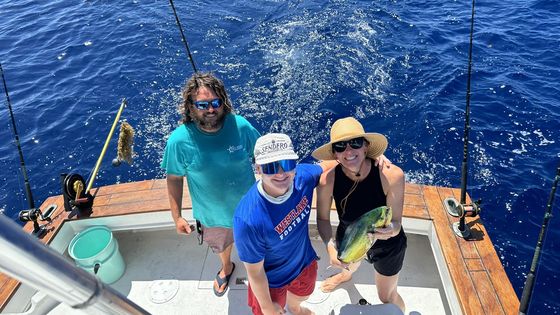
There’s something about fishing from a boat that feels different from fishing from the bank. You can reach the spots no one else can get to. You set your own pace, anchor wherever you want, and stay out as long as the fish are biting. And you don’t have to own a boat to do any of it.
But before you start planning your trip, you probably want to know: how much does renting a fishing boat actually cost?
The honest answer is that it depends — on the type of boat, where you’re fishing, how long you’re out, and whether you’re going it alone or booking a guided fishing charter. This guide walks you through all of it: current pricing by boat type and region, the real differences between renting solo and booking a charter, what species you can target in different parts of the country, and everything you need to know before you head out on the water.
Browse thousands of fishing boat rental options on Getmyboat and Boatsetter to find a great rental or charter for your next fishing trip.
Types of Fishing Boats You Can Rent
Not all fishing boats are created equal. The type of boat you need depends almost entirely on where you’re fishing and what you’re after. Here’s a breakdown of the most common fishing boat types available to rent:
Bass Boats
Sleek, low-profile, and built for speed and precision, bass boats are the go-to choice for freshwater fishing on lakes and rivers. They typically seat two to four anglers and are loaded with features like livewells, rod storage, and a trolling motor for quiet maneuvering in shallow water. If you’re targeting largemouth or smallmouth bass, crappie, or walleye on an inland lake, this is likely your boat.
Typical rental cost: $150–$400 per day
Pontoon Boats (Fishing-Configured)
Pontoon boats aren’t just for parties. Many rental platforms offer fishing pontoons — configured with rod holders, livewells, and fish finders — that are excellent for a relaxed day of fishing with a larger group. They’re ideal for families or groups of mixed experience levels who want comfort as much as catch counts.
Typical rental cost: $250–$700 per day
Jon Boats and Aluminum Fishing Boats
Simple, flat-bottomed, and highly practical, jon boats are workhorses of freshwater fishing. They’re lightweight, shallow-draft, and easy to maneuver in rivers, marshes, and backwater areas where bigger boats can’t go. They’re also among the most affordable rentals on the water.
Typical rental cost: $75–$250 per day
Center Console Boats
The workhorse of saltwater fishing, a center console offers 360-degree fishability with an open layout, rod holders around the gunwales, a livwell, and a console that keeps you out of the way of fishing lines. They’re versatile enough for inshore flats fishing and light offshore trips, and they’re one of the most popular rental types on coastal platforms.
Typical rental cost: $350–$900 per day
Deck Boats and Bay Boats
Sitting between a pontoon and a center console in terms of style and capability, bay boats and deck boats are purpose-built for shallow coastal waters — backcountry flats, estuaries, grass flats, and barrier island channels. They’re favorites for redfish, snook, speckled trout, and flounder.
Typical rental cost: $300–$750 per day
Offshore / Sport Fishing Boats
When you’re heading out to blue water for billfish, tuna, mahi-mahi, or wahoo, you need a serious boat. Offshore sportfishing vessels — including express cruisers, convertibles, and sportfishers — are large, powerful, and equipped with outriggers, fighting chairs, bait tanks, and rod lockers. These are almost always booked as captained charters rather than self-drive rentals.
Typical rental cost (captained charter): $900–$3,000+ per day
Pontoon-Style Party Fishing Barges
In some freshwater destinations, you’ll find large, multi-person fishing barges and pontoons that combine a social atmosphere with a serious fishing setup. These are popular for corporate outings, large group fishing trips, and family reunions where not everyone is a dedicated angler.
Typical rental cost: $400–$900 per day
How Much Does It Cost to Rent a Fishing Boat?
Fishing boat rental prices range widely based on boat type, duration, and location. Here’s a general overview across the most common booking windows:
Hourly Fishing Boat Rental Cost
Some rental operators offer hourly rates, typically with a two- to four-hour minimum. Hourly rates generally run $50–$200 per hour for a self-drive freshwater rental, and $200–$500+ per hour for a captained offshore charter.
Half-Day Fishing Boat Rental Cost (4 hours)
A half-day is one of the most popular fishing trip formats — enough time to get out, find fish, and get back without burning a full day. Half-day fishing rentals typically cost:
- Freshwater self-drive (jon boat, bass boat): $100–$350
- Inshore saltwater (center console, bay boat): $300–$700
- Offshore captained charter: $600–$1,500
Full-Day Fishing Boat Rental Cost (8 hours)
If you want to maximize your time on the water — or if you’re fishing offshore where travel time to the grounds eats into your day — a full-day rental is the way to go. Full-day fishing boat rental prices typically range:
- Freshwater self-drive: $150–$500
- Inshore saltwater self-drive: $450–$900
- Inshore or nearshore captained charter: $700–$1,500
- Offshore captained charter: $1,200–$3,000+
Overnight and Multi-Day Fishing Trips
For dedicated anglers, overnight and multi-day trips offer access to more remote fishing grounds and the chance to target species that bite best at dawn and dusk. Overnight fishing charters and multi-day liveaboard trips start around $1,500 per person and can run $5,000–$10,000+ for a private, fully crewed offshore trip.
Quick tip: Per-person pricing on a shared charter is significantly cheaper than a private boat. Many inshore shared charters run $150–$300 per person for a half day — a great option if you’re solo or with just one other angler.
Fishing Boat Rental Costs by Region
Where you’re fishing is one of the biggest factors in what you’ll pay. Here’s what to expect in the country’s top fishing regions:
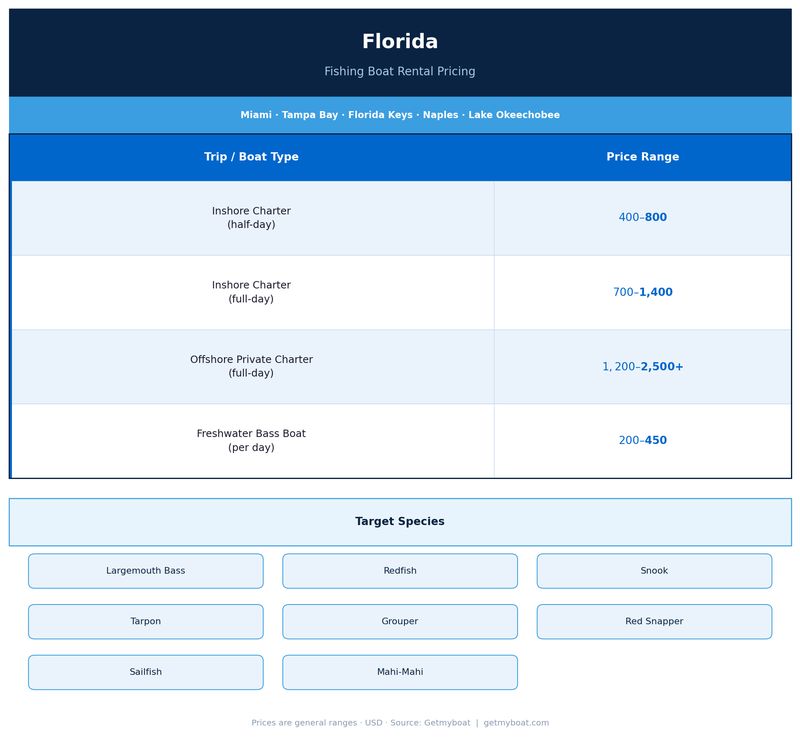
Florida
Florida is arguably the fishing capital of the United States, with world-class opportunities both inshore and offshore virtually year-round. The sheer volume of rental operators keeps prices competitive, though demand in peak season (winter and spring) drives rates up.
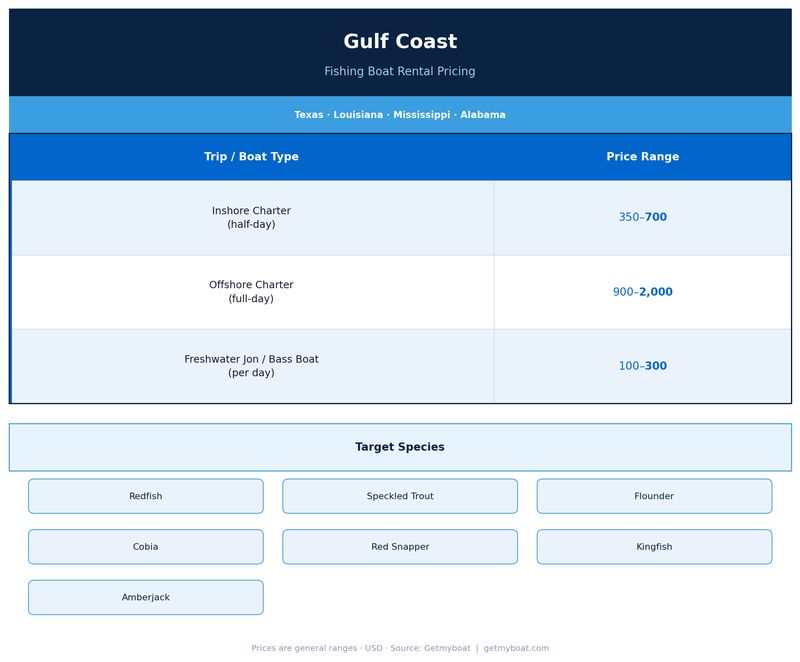
The Gulf Coast (Texas, Louisiana, Mississippi, Alabama)
The Gulf Coast offers outstanding inshore and offshore fishing at prices that tend to be somewhat lower than Florida. Louisiana’s marsh system is legendary for redfish and speckled trout, while Texas offshore trips target red snapper and kingfish.
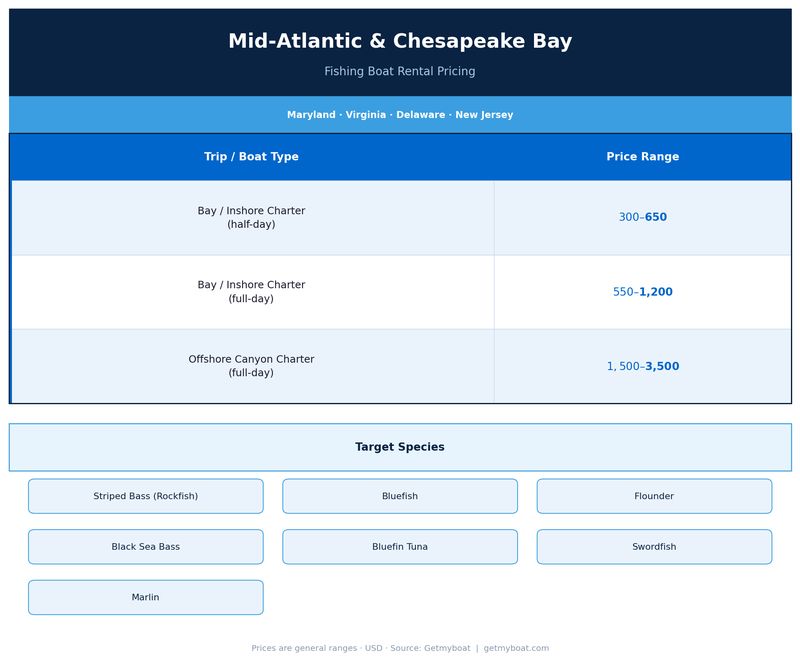
The Mid-Atlantic and Chesapeake Bay
The Chesapeake Bay is one of the most storied fishing grounds on the East Coast, famous for striped bass (rockfish), bluefish, and blue crabs. Offshore trips from Ocean City, Maryland, and Virginia Beach reach deep water for tuna, swordfish, and marlin.
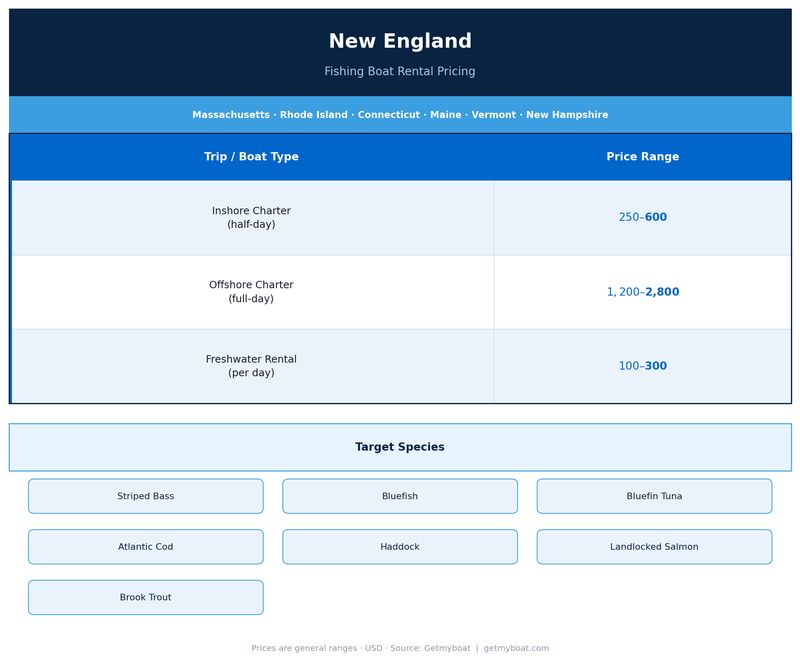
New England
New England fishing is defined by its cold, productive waters and iconic species. From cod and haddock off Cape Cod to striped bass along the Rhode Island coast to bluefin tuna offshore, the fishing is exceptional — if seasonal.
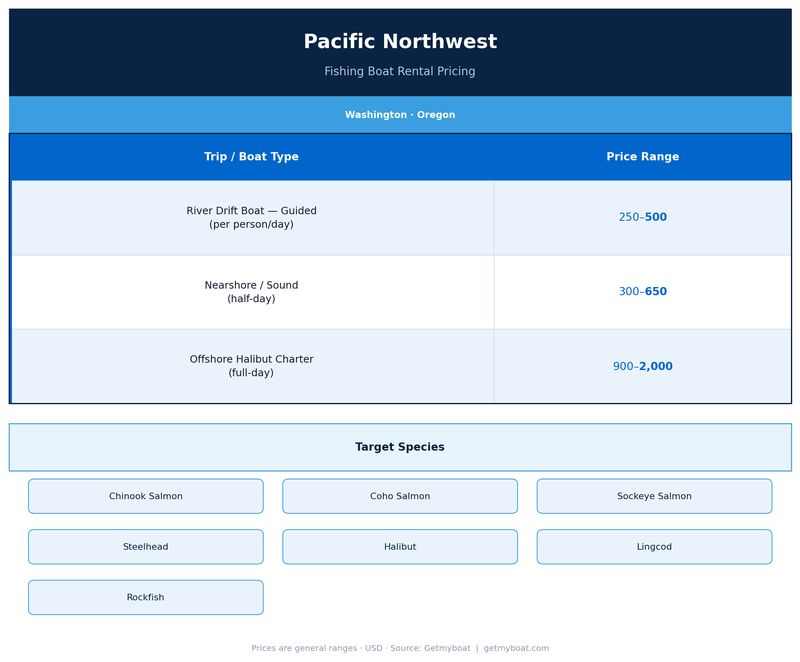
The Pacific Northwest (Washington, Oregon)
Home to legendary salmon and steelhead runs, the Pacific Northwest is one of the most beloved freshwater and nearshore fishing destinations in the world. Drift boats on the Rogue, Deschutes, or Skagit rivers; troll boats on Puget Sound; and offshore trips for halibut define the fishing experience here.
California
California offers great fishing from the inland bass lakes of the Central Valley to the kelp beds of Southern California to the offshore tuna grounds 60+ miles out. Pricing reflects the state’s higher cost of living, but the variety is hard to match anywhere in the country.
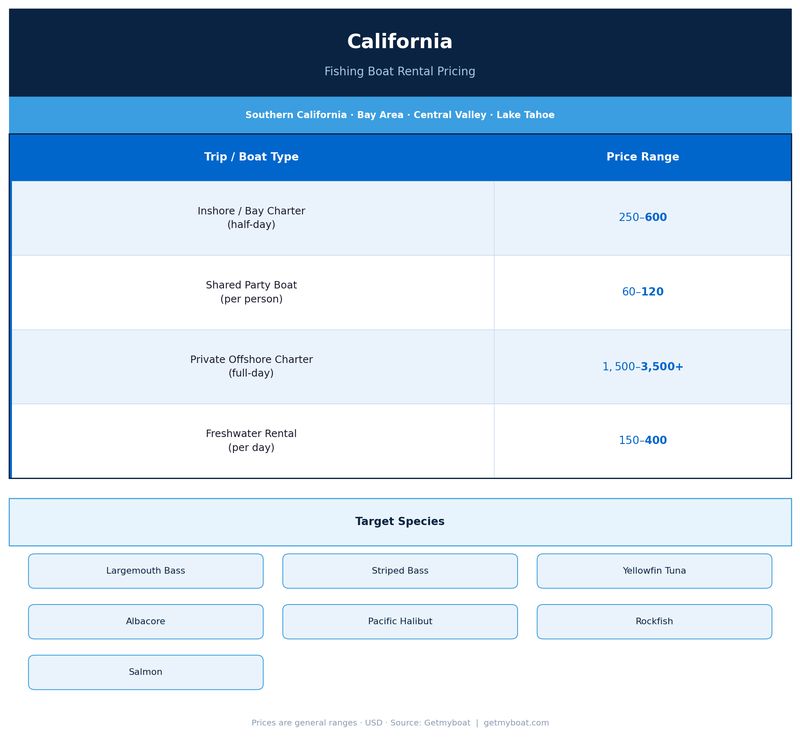
Find great fishing charters in California on Getmyboat.
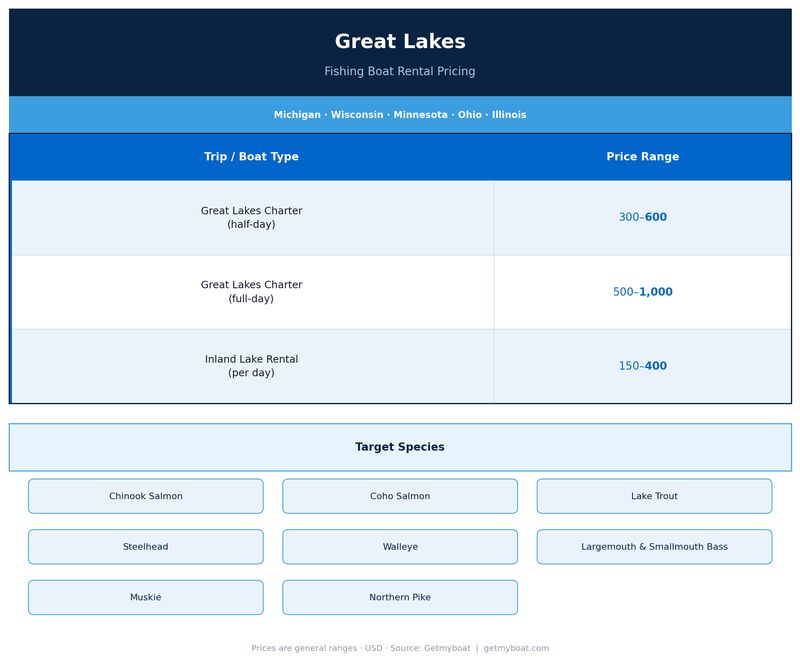
The Great Lakes Region (Michigan, Wisconsin, Minnesota, Ohio)
The Great Lakes offer some of the finest freshwater fishing in the world — and the scale of the lakes means the experience rivals saltwater in many ways. Charter fishing on Lake Michigan for salmon and trout is a bucket-list experience for many anglers.
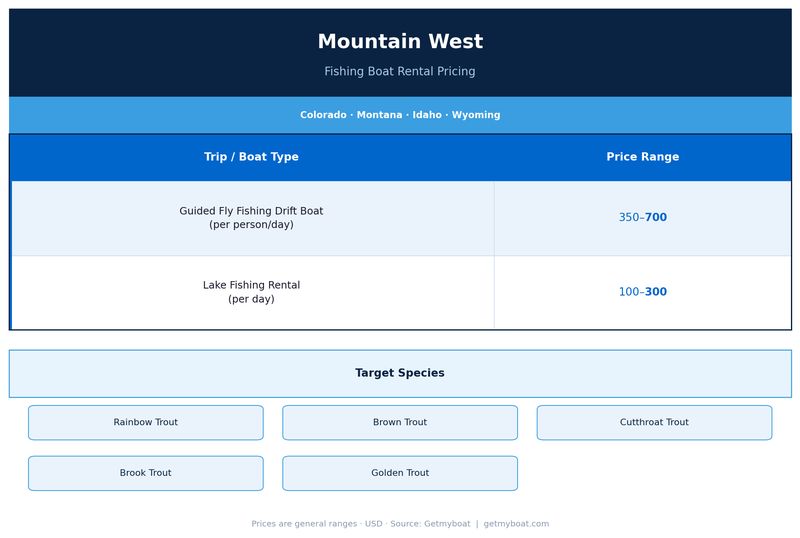
The Mountain West (Colorado, Montana, Idaho, Wyoming)
Fly fishing in the Mountain West is in a category of its own. Float trips on blue-ribbon trout streams — guided drift boats down the Gallatin, Snake, or Colorado River — are once-in-a-lifetime experiences for many anglers. Prices reflect the demand for expert guides and pristine waters.
Fishing Charter vs. Renting a Boat on Your Own: Which Is Right for You?
This is the most important decision you’ll make before booking. Both options have real advantages — and the right choice depends on your experience level, group size, and what you’re hoping to get out of the trip.
Renting a Fishing Boat on Your Own (Self-Drive / Bareboat)
Going out on your own gives you maximum freedom. You choose where to fish, how long to stay, and how to run your day. Self-drive fishing rentals are a great fit for:
- Experienced anglers who know the waters or are comfortable navigating and fishing independently
- Groups of friends or family who want a casual, self-directed day on the water
- Budget-conscious trips where you want to stretch your dollar further
- Freshwater fishing on familiar lakes and rivers where navigation is simpler
The trade-off is that you’re responsible for finding the fish yourself, operating the boat safely, and bringing your own tackle unless the rental includes it. In unfamiliar waters, especially saltwater, going without local knowledge can mean a slow day.
Things to ask before booking a self-drive rental: - Is tackle and bait included, or do I need to bring my own? - Is fuel included or charged separately? - What are the licensing requirements for this waterway? - Are there restrictions on where I can fish or anchor? - What’s included for safety equipment?
Booking a Guided Fishing Charter
A fishing charter means a licensed captain (and often a first mate on larger boats) comes with the boat. They know the water, they know where the fish are, and they bring all the tackle, bait, and rigging you’ll need. Charters are the right call when:
- You’re new to fishing or new to the area and want the best chance at actually catching fish
- You’re targeting offshore or pelagic species (tuna, marlin, mahi, wahoo) where knowing the grounds is everything
- You want a hands-on, educational experience — good guides teach as they go
- You’re fishing with kids or beginners who will benefit from coaching and a highly managed experience
- You’re in a saltwater environment where navigation, tides, regulations, and species knowledge really matter
The added cost of a charter is essentially the cost of expertise — and on many trips, that expertise is the difference between a great day of fishing and going home empty-handed.
What’s typically included in a fishing charter: - Licensed captain (and mate on offshore boats) - All rods, reels, and terminal tackle - Bait (live, cut, or artificial depending on the trip) - Fishing licenses for all passengers (confirm this with your operator) - Basic safety equipment - Fish cleaning at many operators (ask in advance) - Ice for your catch
What to tip: Tipping your captain and mate is customary in the fishing charter industry. The standard is 15–20% of the charter cost, split between captain and mate. On a $800 half-day, that’s $120–$160 — worth it for a great experience.
What Fishing License Do You Need?
Fishing licenses are required in virtually every state, for both freshwater and saltwater fishing. The requirements and costs vary significantly by state, residency status, and type of fishing.
Key things to know: - Most freshwater fishing licenses for residents cost $15–$50 per year; non-resident licenses typically run $30–$100+ - Saltwater fishing licenses are separate from freshwater in most coastal states - Federal permits are required for certain offshore species (like HMS — highly migratory species including tuna, billfish, and swordfish)
When you book a guided fishing charter, the captain’s operator permit usually covers your fishing license for the trip — but always confirm this when booking - When renting a self-drive boat, you are responsible for having the appropriate license for the waterway and species you’re targeting
Most states allow you to purchase a fishing license online within minutes. It’s one of the easiest parts of planning a fishing trip.
What’s Included in a Fishing Boat Rental?
As with any boat rental, what’s included varies by platform and operator. Here’s what you can generally expect:
Usually included: - Life jackets/PFDs for all passengers - Basic safety equipment (flares, fire extinguisher, throwable flotation) - Anchor - Navigation lights - Pre-departure orientation (for self-drive rentals)
Sometimes included (check your listing): - Fishing rods and reels - Tackle and terminal gear - Bait (live or cut) - Fish finder / depth sounder - Cooler and ice - Fuel (more common for shorter rentals)
Usually extra: - Fuel (for longer trips or full-day self-drive rentals) - Fish cleaning and filleting - Specialty equipment (downriggers, outriggers, trolling gear) - Captain/guide (for self-drive rentals — this converts the rental into a charter) - Security/damage deposit (refundable)
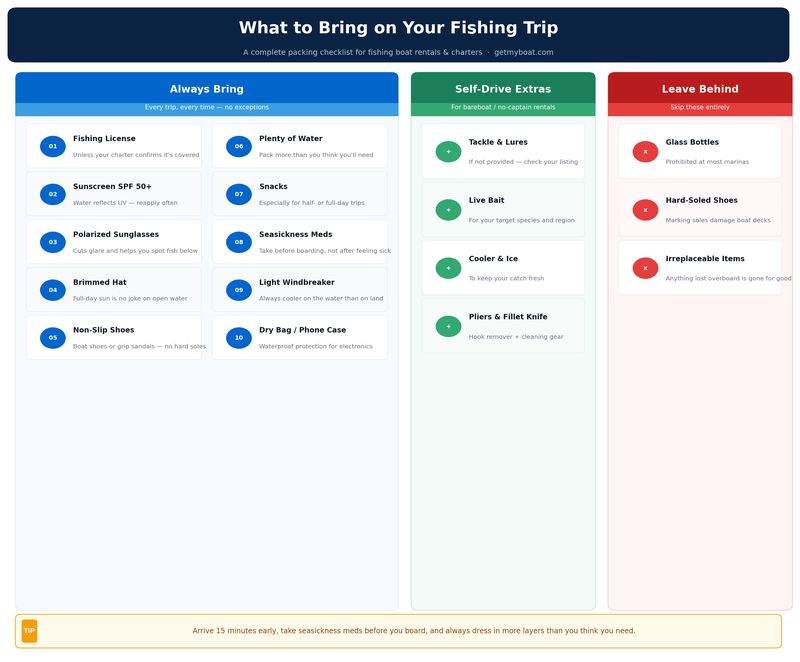
What to Bring on a Fishing Boat Rental
Whether you’re on a self-drive rental or a captained charter, there are a few things worth packing regardless:
Tips for First-Time Fishing Boat Renters
Heading out for the first time? A few things that will make your day significantly better:
Book a charter for your first offshore trip. Open ocean fishing in unfamiliar waters is not the place to figure things out on your own. A captain makes the day exponentially more productive — and safer.
Ask your operator what’s biting. Conditions, seasons, and fish behavior change constantly. A quick conversation with your rental operator or captain before you go will tell you what species to target, what bait is working, and where to focus your efforts.
Go early. Most experienced anglers are on the water at or before sunrise. Fish are more active in low light, and the earlier you go, the more time you have before afternoon winds pick up (especially important on coastal waterways).
Don’t overload the boat. Every fishing boat has a rated capacity for weight and passengers. Stay within it — it’s a safety requirement, not a suggestion.
Respect catch limits. Every state and every fishery has regulations governing how many fish you can keep and what size they must be. Ignorance isn’t a defense. Your captain will handle this on a charter; on a self-drive rental, it’s your responsibility to know the rules before you go.
Practice catch and release. Many anglers keep a few fish for eating and release the rest. If you’re releasing, wet your hands before handling fish, keep them in the water as much as possible, and revive them before letting go. Healthy fish populations are what make great fishing sustainable.
Best Times of Year to Rent a Fishing Boat
Fishing is seasonal, and the best time to rent depends as much on where you’re going as on what you’re targeting. Here’s a general guide:
Spring (March–May): Excellent across most of the country. Bass are spawning in freshwater and highly active. Inshore saltwater species are moving with warming water temperatures. Offshore migratory species begin arriving in Southern waters.
Summer (June–August): Peak season for most coastal and inland destinations. Water is warm, species are abundant, and days are long — ideal for a full day on the water. Offshore fishing peaks in many Atlantic and Gulf Coast destinations. Book well in advance; summer rentals fill up fast.
Fall (September–November): One of the best-kept secrets in fishing. Crowds thin out, rates drop, and fishing often peaks as species feed aggressively before winter. Striped bass runs in the Northeast, salmon returns in the Pacific Northwest, and redfish action in the Gulf are all fall highlights.
Winter (December–February): The off-season in most northern markets, but winter is peak season in Florida, the Gulf Coast, and Southern California, where fishing never really stops. Offshore species like grouper and snapper are in excellent shape, and bass fishing in Florida stays productive year-round.
Frequently Asked Questions About Fishing Boat Rentals
Do I need experience to rent a fishing boat? For self-drive freshwater rentals — especially jon boats and bass boats on calm inland lakes — no extensive experience is required. Most rental operators provide an orientation before you head out. For saltwater and coastal environments, prior boating experience is strongly recommended for self-drive rentals. When in doubt, book a captained charter.
Can I keep the fish I catch? In most cases, yes — within legal limits. Catch limits (also called bag limits or creel limits) are set by state and federal fishery managers and vary by species, season, and location. Your charter captain will know the current regulations; on self-drive rentals, it’s your job to know the rules before you go. Many rental operators and charter marinas offer fish cleaning services for a small fee.
What if I get seasick? Motion sickness is more common offshore than inshore, and it’s worth taking seriously. Take an over-the-counter medication like Dramamine or meclizine the night before and morning of your trip, stay on deck and look at the horizon, avoid reading or looking at your phone, and eat a light meal before going out. If you know you’re prone to seasickness, consider an inshore trip before committing to an offshore one.
Is fishing boat rental covered by travel insurance? Some travel insurance policies cover non-refundable trip costs if a charter is cancelled due to weather. Check your policy carefully, and always review the operator’s own cancellation policy before booking. Most reputable operators will reschedule for free when conditions are unsafe.
How many people can fit on a fishing charter? This depends on the boat type. A private inshore charter typically accommodates two to six anglers. Offshore sportfishing boats can often take six to eight. Larger party boats (open boats) in California and some other markets carry 20–50+ anglers on a per-person ticket. If you want a private experience, book the whole boat.
Can kids come on a fishing rental? Absolutely — and fishing is one of the best things you can do on the water with kids. Inshore charters and freshwater rentals are especially family-friendly. For younger children, a captained charter takes the pressure off parents and keeps the experience fun and safe. Most operators can recommend the right trip for your kids’ ages and attention spans.
Ready to Book Your Fishing Trip?
Whether you’re a lifelong angler ready to explore new waters or a first-timer looking for a beginner-friendly day on the lake, there’s a fishing boat rental or charter out there that fits your plans perfectly. With thousands of options across every state and coastal destination, the hardest part is choosing where to go first.
Browse fishing boat rentals and charters near you — and get out on the water with Getmyboat and Boatsetter.






 4.9 out of 5! 500,000+ reviews