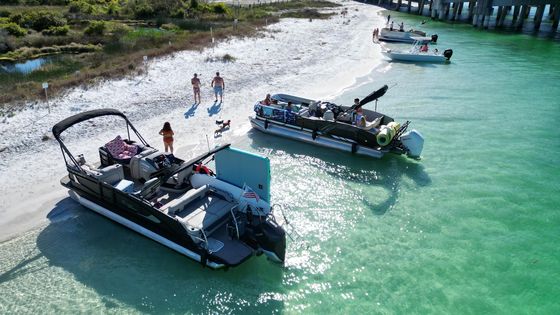
Thinking about renting a pontoon boat but not sure where to start — or how much to budget? You're not alone. Pontoon boats are one of the most popular rental choices in the country, and for good reason: they're spacious, stable, beginner-friendly, and perfect for everything from a laid-back afternoon on the lake to a full-blown birthday party on the water.
This guide covers everything you need to know before you book, including how much a pontoon boat rental actually costs, what's typically included, how many people can come along, whether you need a boating license, and what to expect on the day.
What Is a Pontoon Boat?
Before we get into costs, a quick primer if you're new to boating. A pontoon boat is a flat-decked vessel supported by two or three aluminum cylinders (called "pontoons" or "tubes") that provide buoyancy. Unlike a traditional V-hull boat, pontoons sit on top of the water rather than cutting through it, which gives them a remarkably stable, smooth ride.
That stability is a big part of why pontoons are the go-to choice for casual renters. They don't rock when people move around, they have room for chairs and a cooler, and they're genuinely easy to operate — even if you've never driven a boat in your life. Most are powered by an outboard motor and steered with a wheel, much like a car.
You'll find pontoon boats on lakes, rivers, bays, and calm coastal waterways across the country. They come in a wide range of sizes and styles, from basic fishing-focused boats to luxury "party barges" with built-in speakers, sun decks, and even waterslides.
How Much Does It Cost to Rent a Pontoon Boat?
Pontoon boat rental prices vary depending on location, boat size, amenities, and time of year. Here's a general breakdown of what you can expect to pay:
Hourly Pontoon Rental Cost
Most rental companies offer hourly rates, which typically range from $75 to $175 per hour for a standard pontoon. Premium or luxury pontoons with added features (upgraded audio systems, swim platforms, waterslides) can run $150 to $250+ per hour.
Hourly rentals usually come with a minimum booking window — often two to three hours — so factor that in when comparing prices.
Getmyboat and Boatsetter enable you to comparison shop for different pontoon makes, models, and passenger capacities.
Half-Day Pontoon Rental Cost
A half-day rental (typically four hours) is one of the most popular booking options and usually offers better value than paying hourly. Expect to pay $250 to $600 for a half-day pontoon rental, depending on the boat and location.
Full-Day Pontoon Rental Cost
Full-day rentals (usually eight hours) offer the best per-hour value and are ideal if you want to explore a larger body of water or simply make a whole day of it. Full-day pontoon rental prices generally range from $400 to $1,200, with luxury models at the higher end.
Weekend and Multi-Day Pontoon Rental Cost
Planning a longer trip? Some platforms and marinas offer multi-day rentals for overnight stays, houseboat-style lake trips, or weekend getaways. Multi-day rates can start around $800–$1,000 for two days and scale from there.
Pontoon Rental Costs by Region
Geography plays a big role in pricing. Here's a rough guide to what you might expect in different parts of the country:
Florida (Miami, Orlando area lakes, Keys): One of the most active boat rental markets in the US. Pontoon rentals in Florida typically run $150–$300+ per hour given high demand, fuel costs, and premium waterways.
Midwest Lakes (Minnesota, Wisconsin, Michigan, Missouri): Some of the most affordable pontoon rental markets are in the Midwest. You can often find half-day rentals in the $200–$400 range on popular lakes like Lake of the Ozarks or Lake Minnetonka.
Southeast (Tennessee, Georgia, Carolinas): Mid-range pricing. Popular lake destinations like Lake Norman and Lake Allatoona offer pontoon rentals in the $250–$550 half-day range.
Mountain West (Colorado, Idaho, Montana): Pricing varies by elevation and access, but expect $200–$500 for a half-day on reservoirs like Dillon or Flathead Lake.
Pacific Coast / Pacific Northwest (California, Oregon, Washington): Higher cost of living translates to higher rental rates. Budget $200–$400+ for a half-day in areas like Lake Tahoe or the San Juan Islands.
Northeast (New York, New England): Seasonal market with competitive pricing during summer. Half-day rentals typically run $250–$600 depending on the waterway and proximity to urban centers.
Pro tip: Booking midweek — Tuesday through Thursday — can save you 20–30% compared to weekend rates at many marinas.
What's Included in a Pontoon Boat Rental?
What comes with your rental depends on the platform and the individual boat owner or operator, so it's always worth checking the listing details before you book. That said, most pontoon rentals include:
- Life jackets (also called personal flotation devices or PFDs) for all passengers — required by law in every state
- Basic safety equipment including a throwable flotation device, whistle, and fire extinguisher
- Anchor for stopping and swimming
- Boat orientation before departure, especially for self-drive rentals
- Fuel (often included for shorter rentals, sometimes charged separately for longer ones)
What Might Cost Extra
Some things aren't always included and may add to your total:
- Fuel: For longer or full-day rentals, fuel is sometimes charged at the end based on usage. Ask upfront.
- Captain or skipper: If you want a licensed captain to do the driving, expect to add $100–$300+ to your rental cost, depending on the duration. More on this below.
- Watersports equipment: Towable tubes, wakeboarding, or paddleboard gear is often available as an add-on.
- Cooler, ice, or supplies: Some boats come equipped; others don't.
- Security deposit: Most rentals require a refundable deposit of $200–$500 on a credit card.
- Cleaning fee: Some listings include this for parties or larger groups.
How Many People Can Fit on a Pontoon Boat?
One of the biggest advantages of renting a pontoon over other boat types is capacity. Pontoon boats are purpose-built for groups, and they tend to have among the highest passenger limits of any recreational rental vessel.
Here's a general guide by boat size:
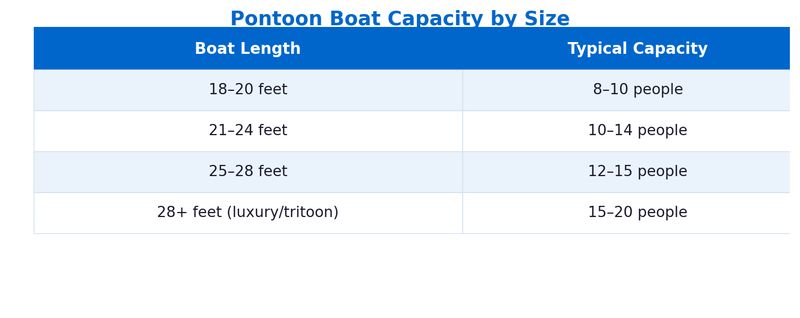
Every pontoon boat is legally required to display its maximum capacity rating, which accounts for both the number of people and total weight. Always stay within the posted limit — it's not just a suggestion, it's a safety requirement.
If you're planning a larger gathering, some rental services can arrange two boats side by side for an unofficial "flotilla" experience.
Do You Need a License to Rent a Pontoon Boat?
This is one of the most common questions from first-time renters — and the answer is: it depends on your state and age.
In the US, boating license requirements vary by state. Many states don't require a traditional "license" per se, but they do require a boater safety certificate if you were born after a certain year (commonly 1988 or later). Completing a boater safety course — which can be done online in a few hours for around $20–$40 — typically satisfies this requirement.
Some states with stricter regulations (like California, Florida, and New York) have more specific requirements based on age or the type of vessel. Your rental provider will let you know what documentation you need in advance.
If you'd rather skip the paperwork entirely, renting with a licensed captain is always an option and removes any licensing concerns for you and your group.
Bottom line: Check your state's requirements before booking. Most first-time renters are pleasantly surprised by how accessible it is — pontoons are specifically designed to be renter-friendly.
Do You Need Experience to Rent a Pontoon Boat?
Not really — and this is one of the reasons pontoons are so popular with first-timers. Pontoon boats are widely considered the easiest boats to operate. Their wide, stable platform and outboard motor make them far more forgiving than speedboats or sailboats, and their handling is intuitive for anyone who's driven a car.
That said, you'll still want to pay attention during the pre-departure orientation your rental provider gives you. They'll cover how to start and stop the engine, how to dock, what to do in an emergency, and any waterway-specific rules (no-wake zones, speed limits, restricted areas).
A few things worth knowing as a first-timer:
- Docking is the trickiest part for most beginners — take your time and don't be embarrassed to go slow
- Wind and current can affect how the boat moves at low speeds, especially when maneuvering in a marina
- No-wake zones are strictly enforced in many areas; maintain slow speed near docks, swimmers, and marked zones
- Pontoons are not ideal for rough water or open ocean — they're best on lakes, rivers, bays, and protected coastal waters
If you're nervous, booking a captained pontoon rental for your first outing is a great way to learn the ropes without the pressure of being at the helm.
Captained vs. Self-Drive Pontoon Rentals
One of the first decisions you'll make when booking is whether you want to drive yourself or hire a captain.
Self-drive (bareboat) rentals are the most common option. You're in charge, you set your own itinerary, and you have the freedom to explore however you'd like. Most rental platforms provide a full safety briefing, and many include a short orientation on the water before you depart solo.
Captained rentals include a licensed, experienced captain who takes care of all the navigation. You and your group simply relax and enjoy the ride. This option is popular for special occasions, larger groups, or anyone who wants a more curated experience — think sunset cruises, fishing charters, or sightseeing trips.
Captained rentals tend to cost 20–50% more than self-drive, but many people find the peace of mind and the elevated experience well worth it.
Best Uses for a Pontoon Boat Rental
Pontoon boats are remarkably versatile, which is part of what makes them so popular as rentals. Here are some of the most common (and most fun) ways people use them:
Family outings: The stable platform and spacious layout make pontoons a natural choice for families with kids. Plenty of seating, easy boarding, and a laid-back pace make for a stress-free day.
Birthday and bachelorette parties: A pontoon is essentially a floating venue. Add a Bluetooth speaker, a cooler stocked with drinks, and a group of friends, and you have an unforgettable party setup.
Swimming and snorkeling: Most pontoons have a swim ladder at the stern, making it easy to hop in and out of the water. On clear-water lakes or calm coastal spots, this is hard to beat.
Fishing: Many pontoon rentals are set up for fishing with rod holders and live wells. They're especially popular on bass lakes and coastal inlets where a large, quiet platform is an advantage.
Sunset cruises: An evening on the water watching the sun go down is one of those experiences that's genuinely better than you expect. Bring snacks, a playlist, and good company.
Waterfront dining and exploration: Pontoons give you access to waterside restaurants, hidden coves, sandbars, and coastal villages that you simply can't reach any other way.
What to Bring on a Pontoon Boat Rental
A little preparation goes a long way. Here's what to pack for a great day on the water:
- Sunscreen (reef-safe if you're in a coastal or natural waterway)
- Sunglasses and a hat — reflection off the water intensifies UV exposure
- Water and snacks — more than you think you'll need
- A cooler (check if the boat has one; if not, many rentals allow you to bring your own)
- Towels and a change of clothes if you plan to swim
- Waterproof phone case or dry bag for electronics
- Layers or a light jacket — it gets cooler on the water than on land, especially in the morning or evening
- Motion sickness medication if you're prone to it (though pontoons are so stable this is rarely an issue)
- Cash or card for fuel charges or any marina fees
Leave behind: high heels or hard-soled shoes (non-slip footwear or bare feet are best), anything you can't afford to lose overboard, and glass bottles (many marinas prohibit them).
How to Book a Pontoon Boat Rental
Booking a pontoon has never been easier thanks to online marketplaces that connect renters with boat owners and charter operators in one place. Here's what the process typically looks like:
- Search by location and date. Enter where you want to rent and when, and browse available pontoons in your area.
- Filter by group size, price, and features. Most platforms let you filter by capacity, price range, whether a captain is included, and amenities.
- Read the listing carefully. Pay attention to what's included, the cancellation policy, fuel terms, and any special requirements.
- Check reviews. Previous renters' experiences are often the most useful guide to whether a boat and operator are worth booking.
- Book and pay securely online. A deposit is typically collected at booking, with the remainder due before departure.
- Show up ready. Arrive a little early, bring your ID and any required boating safety certificate, and be ready for your pre-departure briefing.
Frequently Asked Questions About Pontoon Boat Rentals
How far in advance should I book a pontoon rental? For popular destinations or summer weekends, booking two to four weeks in advance is a good rule of thumb. Holiday weekends (Memorial Day, Fourth of July, Labor Day) can book up months ahead. Midweek bookings offer more flexibility and often better rates.
Can I take a pontoon boat on the ocean? Generally, no. Pontoon boats are designed for calm inland waters — lakes, rivers, bays, and protected harbors. Open ocean conditions (waves, swells, boat wake from large vessels) can be genuinely dangerous in a pontoon. If you want an ocean experience, look for a catamaran, bowrider, or center console rental instead.
What happens if it rains? Most rental platforms have weather-related cancellation policies that allow you to reschedule or receive a refund if conditions make boating unsafe. A light drizzle usually isn't a dealbreaker — many pontoon renters actually enjoy it — but thunderstorms are a hard stop. Check the cancellation policy before you book.
Is there a weight limit on pontoon boats? Yes. Every boat has a rated capacity for both people and total weight. The rating is posted on a plate inside the boat. Exceeding it is illegal and genuinely dangerous.
What if something goes wrong on the water? Your rental provider will give you emergency contact numbers and protocols before you depart. The US Coast Guard is always reachable via VHF radio Channel 16 or by calling 911. Most rental companies also ask you to check in by phone if you run into any issues.
Ready to Book a Pontoon Boat?
Now that you know what to expect — and what it costs — all that's left is finding the right boat. Whether you're planning a family lake day, a summer party with friends, or a peaceful sunset cruise, there's a pontoon rental out there that fits your group, your budget, and your plans.
Browse pontoon boat rentals near you on Getmyboat and find your perfect day on the water.






 4.9 out of 5! 500,000+ reviews