You’ve booked an incredible boat day — maybe it’s a sunset cruise, a fishing charter, or a catamaran adventure — and you’re excited. But there’s a nagging worry in the back of your mind: What if I get seasick?
First, take a breath. Seasickness is incredibly common (up to one-third of people experience it even in mild conditions), it’s well-understood, and most importantly, it’s very manageable. Whether you’ve struggled with motion sickness before or you’re just nervous about your first time on open water, this guide covers everything you need to know.
Why Does Seasickness Happen?
Seasickness is a form of motion sickness rooted in a conflict between your senses. When you’re on a moving boat, your inner ear senses the rocking and rolling of the water. But your eyes — especially if you’re below deck or focused on a phone or book — may be sending a different signal to your brain, telling it that things are relatively still.
Your brain doesn’t know what to believe, and that confusion triggers a cascade of symptoms: nausea, dizziness, cold sweats, fatigue, and vomiting. It’s an involuntary neurological response, not a sign of weakness. Even experienced sailors can get it — and stress or anxiety about getting sick can actually make it more likely.
Before You Board: Prevention Is Everything
The single most important piece of advice: plan ahead. Most remedies work best when taken before symptoms start. Trying to recover from full-blown seasickness mid-trip is much harder than preventing it in the first place.
Choose the Right Day and Boat
If you have flexibility, check the marine forecast before heading out. Calmer water means less motion. On Getmyboat, many listings note the type of experience and conditions — a sheltered lake or bay is very different from offshore swells. Catamarans are especially stable and a great choice for motion-sensitive passengers.
Watch What You Eat and Drink
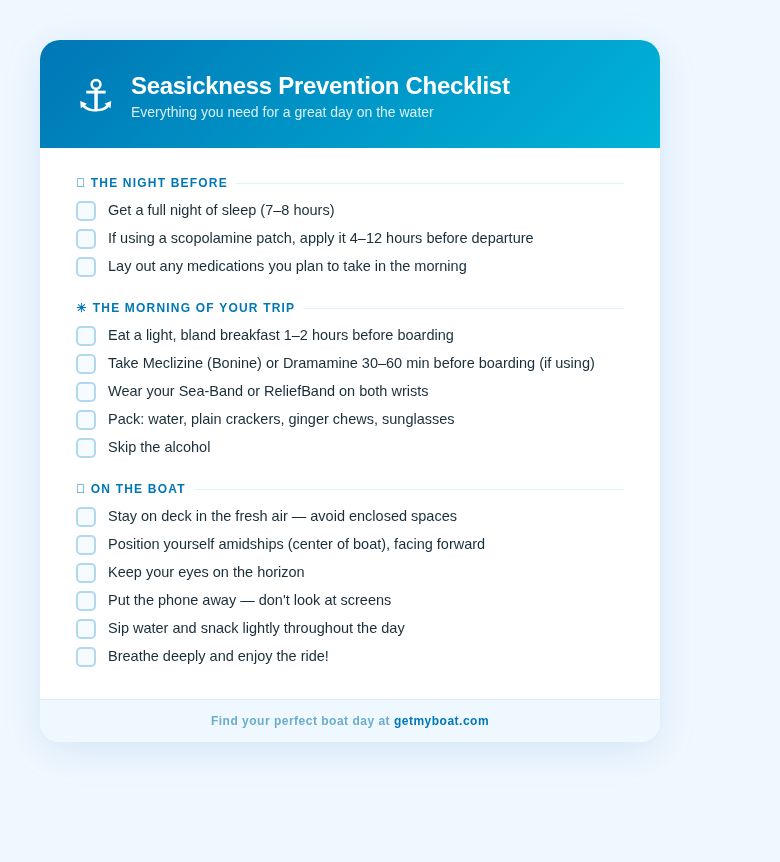
- Eat a light, bland meal 1–2 hours before boarding. An empty stomach worsens nausea, but a heavy or greasy meal is equally problematic. Think crackers, toast, oatmeal, or a light sandwich.
- Avoid alcohol before and during the trip — it dehydrates you and makes seasickness significantly worse.
- Stay hydrated. Dehydration amplifies every symptom. Sip water throughout the day.
- Skip the coffee on the morning of your trip if you’re sensitive; caffeine can increase anxiety and stomach sensitivity.
- Ginger is your friend. Ginger ale, ginger tea, or ginger candies before you board have been shown in studies to help reduce nausea.
Get a Good Night’s Sleep
Fatigue significantly increases susceptibility to seasickness. Try to get 7–8 hours the night before. Don’t make the mistake of staying up late the night before an early morning charter.
On the Boat: Tips and Tricks That Actually Work
Find Your Sweet Spot
- Stay on deck and in fresh air. Below-deck cabins and enclosed spaces are nausea traps.
- Position yourself amidships — the center of the boat at water level. The bow bounces the most; amidships is the most stable.
- Face forward in the direction of travel.
Fix Your Gaze on the Horizon
This is the single most effective in-the-moment trick. The horizon is stationary and distant, and focusing on it helps your brain reconcile the conflicting signals from your inner ear. If the horizon isn’t visible, looking at a fixed point on land works too.
Avoid reading books, looking at your phone, or watching video on a screen — these are among the fastest ways to trigger seasickness.
Breathe Deeply and Stay Calm
Slow, deep, rhythmic breathing can reduce nausea and help manage the stress response. If you feel a wave of queasiness coming, take 5–6 slow, deep breaths and focus on the horizon.
Stay Cool
Heat and stuffiness worsen nausea. Position yourself where there’s a breeze, step away from engine fumes, and if you feel hot, place a cool damp cloth on your wrists or the back of your neck.
Eat Lightly Throughout the Day
If the trip is longer, snack lightly on bland foods — crackers, pretzels, plain bread — rather than eating a big meal. Keeping something in your stomach can help, but avoid anything rich, fatty, or strongly scented.
Products That Can Help
There are excellent options across the spectrum from all-natural to prescription-strength. Many experienced boaters combine a couple of approaches for best results.
Over-the-Counter Medications
Dramamine (Dimenhydrinate)
One of the most widely used motion sickness remedies. Take it 30–60 minutes before boarding. The main side effect is drowsiness. A “Non-Drowsy” formula (Meclizine) is also available.
Bonine / Antivert (Meclizine)
Generally considered the gold standard OTC option for boating. It’s an antihistamine that works on the vestibular system with less drowsiness than Dimenhydrinate. Take it 1 hour before your trip; effective for up to 24 hours.
Note: All antihistamine-based medications cause some drowsiness and can interact with alcohol. Do not drink alcohol if taking these medications.
Natural and Drug-Free Options
Ginger
Ginger has solid clinical evidence for reducing nausea. Options include Sea-Band Nausea Relief Ginger Lozenges, Chimes Ginger Chews, Gravol Natural Source Ginger Capsules, and fresh ginger tea before boarding.
Sea-Bands (Acupressure Wristbands)
Sea-Bands are elastic wristbands that apply pressure to the P6 acupressure point on the inner wrist. Drug-free with zero side effects — great for children or pregnant women. Wear on both wrists about 30 minutes before boarding.
ReliefBand
A wearable device that uses mild electrical pulses (neuromodulation) to stimulate the median nerve on the wrist. FDA-approved with stronger clinical evidence than acupressure bands. Costs $100–$200 but beloved by serious boaters. Can be turned on mid-trip if needed.
Queasy Pops / Preggie Pops
Herbal lollipops with ginger, peppermint, and other botanicals. A gentle, pleasant option — great for kids.
Prescription Options
If OTC products haven’t worked for you in the past, talk to your doctor before your trip.
Scopolamine Patch (Transderm Scop)
The go-to prescription option for boating. A small patch placed behind the ear delivers medication continuously for up to 72 hours. Widely considered the most effective single treatment available. Apply 4–12 hours before boarding. Ask your doctor or a travel medicine clinic.
Ondansetron (Zofran)
Originally developed for chemotherapy-related nausea, sometimes prescribed off-label for severe motion sickness. One of the strongest anti-nausea medications available and well-tolerated by most people.
Important: Speak with a doctor or pharmacist before combining any of these medications. Prescription options should be discussed at least a week before your trip.
If You Start Feeling Sick Mid-Trip
Even with the best preparation, sometimes it happens. Here’s how to manage it:
- Get outside immediately and breathe fresh air.
- Fix your gaze on the horizon — don’t look down or at your phone.
- Move to amidships if you’re not there already.
- Sit or lie down facing forward. If you must lie down, keep your head still.
- Sip cold water or ginger ale slowly.
- Don’t fight it. If you need to vomit, it’s better to let it happen — you’ll often feel significantly better afterward.
- Tell the captain. A good captain has seen this before and may be able to adjust speed or route to help.
Special Considerations
Children
Children between ages 2–12 are more susceptible to motion sickness than adults. Most outgrow it by their teenage years. Tips for younger kids:
- Choose calmer water conditions and stable vessels (catamarans are ideal).
- Keep them looking outward — spotting dolphins, watching waves — rather than at a screen.
- Offer ginger chews or Queasy Pops.
- Children’s Dramamine is approved for kids 2 and up (check label for dosing).
- Sea-Bands are safe and drug-free for children of all ages.
- Always consult your pediatrician before giving any medication.
Pregnancy
Pregnant women are particularly prone to nausea, and boat motion can make it worse. Sea-Bands and ginger are considered safe options. Always consult your OB or midwife before taking any medication — including over-the-counter options — during pregnancy.
The Mental Game: Don’t Let Anxiety Win
Anxiety about getting seasick can actually make it more likely. If you’re spending the whole trip tensed up and monitoring your stomach, you’re primed for a rough time.
The most seasoned sailors will tell you that distraction, engagement, and enjoyment are genuinely powerful tools. Focus on the experience: the view, the company, the activity. Talk to your captain or fellow guests. Watch for wildlife.
The more boat days you do, the easier it gets. Many people find that after a few trips, their body adapts — this is called “sea legs,” and it’s real. Don’t let one cautious first outing put you off a lifetime of adventures on the water.
Ready to get on the water? Book a captained charter with a professional captain from Getmyboat.






 4.9 out of 5! 500,000+ reviews